Table of Contents
- Start With a Room-by-Room Fire Risk Review
- Review Suppression Equipment Without Attempting Repairs
- Build a Simple Inspection Calendar and Record System
- Protect Exit Paths, Lighting, and Emergency Response
- Understand the New Jersey and New York City Difference
- Common Questions
- Make Fire Safety Part of the Workday
From neighborhood restaurants in Bergen and Essex counties to food-service operations serving commuters near the Hudson, commercial kitchens must manage heat, grease, fuel, electrical equipment, and fast-moving shifts at the same time. For operators researching emergency fire suppression equipment in New York City, My Durable Solutions offers a New Jersey-focused website centered on fire suppression equipment. It provides a useful regional reference point for owners and managers who need to understand the equipment and readiness steps that support safer kitchen operations.
Fire readiness is not a task reserved for the day before an inspection. It is a routine built into opening, closing, cleaning, maintenance, and staff training. When equipment remains accessible, records are organized, and employees understand their roles, a team can respond more clearly during a stressful event.
Start With a Room-by-Room Fire Risk Review
Walk the property in zones rather than relying on a quick glance from the kitchen door. A short, consistent review helps managers spot conditions that can be corrected before service begins.
- Cooking line: Check fryers, ranges, ovens, grills, burners, and surrounding clearance.
- Hood and duct area: Look for grease accumulation, obstructed filters, or items stored where they do not belong.
- Storage: Keep cardboard, paper goods, chemicals, and other combustible materials away from heat sources and electrical equipment.
- Electrical areas: Watch for damaged cords, overloaded receptacles, and blocked electrical panels.
- Dining and exit areas: Keep travel paths, extinguishers, exit signs, and doors visible and accessible.
Review Suppression Equipment Without Attempting Repairs
Check the Kitchen Suppression System
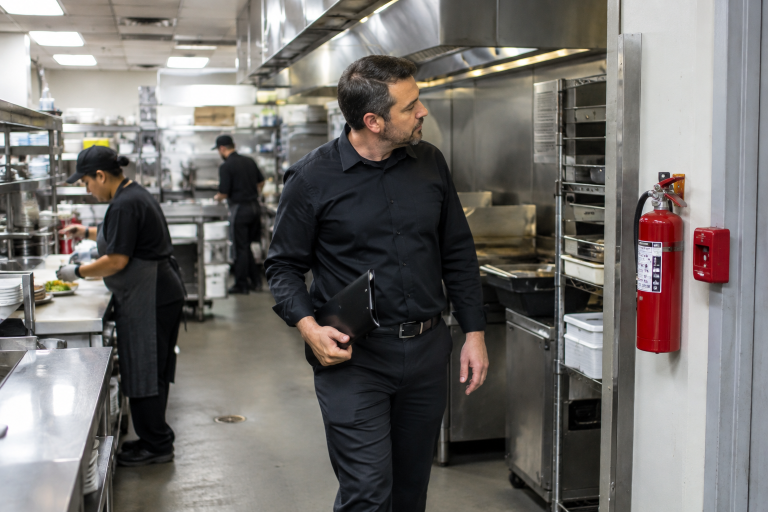
A manager can complete basic visual checks without touching technical components. Confirm that manual pull stations are visible and reachable, discharge nozzles are not blocked by cookware or decorations, and service tags or records are present. Look for loose parts, corrosion, damage, or signs of tampering. Staff should not reset, modify, test, or repair a system unless they are trained and authorized to do so.
Any deficiency deserves a documented follow-up. If a system has been activated, has visible damage, or appears out of service, limit unsafe cooking activity as appropriate and contact a qualified fire protection contractor before treating the equipment as ready again.
Keep Fire Extinguishers Visible and Suitable
An extinguisher is useful only when it is accessible, appropriate for the hazard, and maintained. Keep units mounted or placed in their intended locations, free from boxes and equipment. During visual checks, look for intact pins, seals, handles, hoses, and pressure indicators, then review inspection tags. Every employee should know where extinguishers are located, but should attempt to use one only when the fire is small, an exit remains clear, and the employee has been trained to respond safely.
Build a Simple Inspection Calendar and Record System
- Every shift: Clear exits, access paths, pull stations, and extinguisher locations.
- Each month: Review visible equipment condition, emergency lighting, exit routes, and staff knowledge.
- On the required service schedule: Arrange professional inspection and maintenance for suppression equipment and extinguishers.
- After a kitchen change: Recheck nozzle coverage, equipment placement, fuel connections, and clearances.
- After an activation: Keep the affected system out of normal service until it has been inspected and restored properly.
Keep service reports, repair invoices, activation records, staff training notes, and routine checklists in one shared digital folder or labeled binder. In New Jersey, managers can use the state’s fire protection equipment contractor certification information when checking whether a provider is properly permitted for the work involved. Open deficiencies should be assigned, tracked, corrected, and verified.
Protect Exit Paths, Lighting, and Emergency Response
Smoke, noise, crowding, and power loss can turn a manageable incident into a life-safety emergency. Test emergency lighting according to the building’s required process, confirm that exit signs are visible, and make sure doors, hallways, and stairways are not narrowed by carts, deliveries, or supplies. Strong suppression equipment cannot compensate for a blocked exit.
Training should reach every shift, not only management. During onboarding and refresher training, show employees the locations of exits, extinguishers, manual pull stations, and relevant fuel shutoffs. Keep procedures simple: notify others, call emergency services, evacuate when conditions are unsafe, meet responders, and account for staff outside.
Understand the New Jersey and New York City Difference
Requirements can vary by jurisdiction, building type, cooking equipment, and project scope. A checklist that works for a restaurant in Hoboken, Jersey City, or Newark may not apply unchanged across the river. New York City businesses planning a new installation or equipment rearrangement can review the city’s rangehood fire-suppression system requirements before assuming that an existing setup still meets local expectations. Confirm the applicable rules with the authority having jurisdiction, the equipment manufacturer, and the qualified contractor.
Common Questions
How often should a commercial kitchen suppression system be checked?
Staff can perform routine visual checks, while professional inspection and maintenance should follow the requirements for the system, location, and authority having jurisdiction.
Can employees test or repair fire suppression equipment?
Employees may perform limited visual checks when trained. Technical testing, repairs, recharging, and adjustments should be handled by qualified professionals.
What records should a restaurant keep?
Keep inspection reports, service tags, repair documentation, staff training records, evacuation notes, activation records, and proof that identified deficiencies were resolved.
Make Fire Safety Part of the Workday
Commercial kitchen fire readiness comes from repeatable actions, not complicated paperwork. Clear exits, suitable equipment, visible pull stations, current records, trained staff, and qualified service all support a safer workplace. A consistent routine gives restaurant teams in New Jersey and nearby New York City markets a practical way to stay prepared through busy service and beyond.
About the Author


